
On Wandering and Wanderers
In the 72 years I have been resident on planet Earth I have wandered 67 billion kilometers around the sun – traveling at 30 km per second. Close to a billion km a year. And the entire galaxy is wandering off into space too, along with everything else. Pretty darned cool zipping along like that, except that somewhere along the way I lost my hat and I somehow doubt I will return any time soon to retrieve it from some inter-galactic ditch.
Galaxy image: NASA, Hubble Space Telescope
When I moved to Victoria in the early 1970s, Louise (my ex and now cherished friend) and I lived in a tiny suite in a grand old house on Woodstock Avenue converted into a warren of rooms. Our place was the former library of the manor, cozy, dark and deeply comforting with a large fireplace and stained glass windows. I built a rudimentary fold-up bed that fit into a nook under the windows saving us a few precious square feet of real estate. A small glassed-in alcove served as a kitchen that was flooded with light and a view of a venerable apple tree. The yard itself surrounded by a tall cedar hedge on a tree-lined street close to Beacon Hill Park and the cobbled beaches below the escarpment off scenic Dallas Road. Our wandering had brought us to an enchanting place in a magical time. Hobbits we were. Thankful to be warm and cozy after wandering afar on a long adventure.
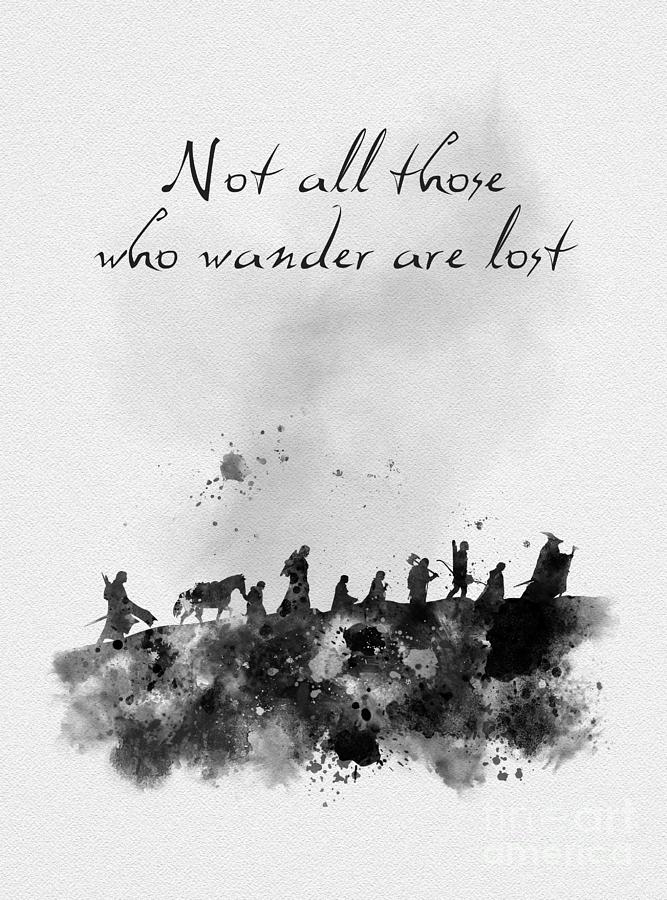
Not all those who wander are lost;
The old that is strong does not wither,
Deep roots are not reached by the frost.
From the ashes a fire shall be woken,
A light from the shadows shall spring;
Renewed shall be blade that was broken,
The crownless again shall be king.”
– J.R.R. Tolkien, The Fellowship of the Ring

Image: Province of B.C.
We had recently arrived from Hinton, via a short stint in Prince George, after hitchhiking across Canada to Montreal (leaving just before the FLQ triggered the October Crisis of October 1970). Alberta and northern British Columbia were still suffering through the depths of a particularly bitter winter. We hitched out of Prince George that was still covered in three feet of dirty snow. In Williams Lake, a mere 150 miles to the south, the wind was blowing clouds of dust and grit along the highway where we stuck out our thumbs vainly hoping for a lift from cowboys in rumbling pickup trucks who generally had notable disdain for hitchhikers unless they had a three pound nickle-plated rodeo belt buckle and a well worn saddle slung over their shoulder. We had a sketchy backpack and a macrame handbag so it took us a while before someone took pity on us. Good opportunity for them to practice Christian charity on a couple of obviously wayward souls.
By the time we reached the West Coast a few days days later the apple and cherry blossoms were in full bloom. Their delicate petals floating in the air blessed us as we strolled beneath them lost in a sense of awe and wonder. How could anything here on earth be so sublimely beautiful? Our arrival in the Garden City reinforced in us the marvels of traveling and discovering the newness of place. This chapter in my life undoubtedly had a big impact on me. I notice in writing this that I have written about them several times before and I often re-visit them in both thoughts and stories. (You can see my further reflections in a tribute to an old friend Garney (aka, Garnet Coburn) who lived on the top floor of the Woodstock Manor. (See Forthcoming Blog: Quest for a Long-Lost Friend, in HippieTrails section.)

Image: CTV News
This journey to Victoria was more than just another road trip; it was a time of rebirth for us, the chance to re-write our life story. Although the previous year had been filled with many wonderful adventures both earthly and divine, it had also been a very stressful time for not only ourselves but also across Canada – martial law was declared in Quebec with tanks on the streets of Montreal where we had just walked so blissfully enjoying the liveliness and laughter of the people and the cadence of the French language. The hippie dream was encountering other hard realities of drink, drugs and high unemployment. There were no jobs anywhere, especially for a long-haired, high school drop/kick out, namely me. To top it off we had an altercation with a pulp truck, on River Road between Hinton and Entrance, where we were heading for a late night gathering at our old hippie house, on the first night back from Montreal. Louise broke her leg rendering her unable to work at her occupation as a hair stylist. Tough times were in store.
Image: miupress.org
Then, in the midst of one of the most depressing times of my life, we learned Transcendental Meditation (TM) in that, seemingly, most unlikely of places, the smoky pulp mill town of Prince George, a staunchly working-class town deep in the heart of the boreal forest. Hundreds of miles of spruce and pine trees stretched out in all directions and the hard-working, beer-drinking, locals saw themselves as rugged individuals living on the edge of the wilderness. Big-hearted, but tough. Party hard on Saturday night but still get up for church on Sunday morning – or pull your buddy out of the muskeg. And always get to your shift at the mill on time no matter how late the night or how bad the hangover. This was a big part of my background too. Working-class heroes.
It was here in the land of chainsaws, pulp trucks, skidoos, moose hunters and fishermen that there ventured a couple of itinerant TM teachers, Jack Dykes from the Okanagan and David Ristich from Vancouver. They introduced us to Maharishi Mahesh Yogi, the founder of the worldwide TM Movement, and modern exponent of the ancient Vedic tradition of India, including Transcendental Meditation. How cool was that! I revel in the fact that I learned to meditate in Prince George. Somehow it is just so fitting for me. Love it!
In Victoria the dark shadow that had been following us since the night of the accident lifted and a sense of wonder at life readily returned. We met many incredible TM practitioners, like Paul Horn, the jazz/new age musician and TM Teacher, at the local TM Centre and made many new friends who were on a sacred journey of their own. We began to see ourselves as on a spiritual pilgrimage where travelling was not only done on paved highways, gravel roads and mountain trails, but also inside our own selves.
The realm of imagination opens up our vistas on the universe, sometimes blurring the boundaries between fantasy and reality. Louise was a voracious reader and through her we discovered Tolkien and his multi-layered books, The Hobbit and his epic Lord of the Rings. Somehow her voice perfectly captured the cadence of the elves, hobbits, sorcerers and other mythical beings Tolkien had conjured up. We spent many hours sitting on cushions in front of the fireplace and drinking herbal tea while Louise tirelessly read those books aloud. Sometimes friends would join us for a chapter or two. All of were in rapture . We entered into those enchanted realms both through the power of Tolkien’s masterful storytelling and Louise’s richly cadenced storytelling voice. Wonderful stuff….
One of those who joined us for story night from time to time was our semi-mythical friend, Denis. The first of these occasions came after dark not long after we moved into the Woodstock house. A knock came at our door. No one ever came calling on us especially late at night. What the…??? But there he was Denis, hair down to waist, small back pack and a mile-wide grin on his face. We hadn’t seen him in several years but somehow he had tracked us down (no phone in those days and we only very recently had a fixed address). He effortlessly slipped into our lives and took his rightful seat in front of the fire and shared in the tea and stories as if he had always been there. To us, in the rarefied air of storytime, Denis was no less than a Gandalf or a Strider, certainly not a stay-at-home Hobbit. He was always secretive, appearing and disappearing without notice or explanation. One day he would be there drinking tea with you and giving you a set of carving tools then he was off on his travels again – to San Francisco, the high desert of the Andes mountains, down the Amazon River, afloat on the Caribbean. And where else, we likely will never know?
There, are of course, many ways to wander through this world. Some people find a sacred path. When I look back on friends from my younger years I marvel at the variety of traditions and spiritual practices they have explored or embraced including many Christian paths – devout Catholics, Baptists, Jehovah’s Witnesses, Mormons. One old hippie buddy even leads an evangelical congregation in a small Alberta town. There are also Hindus, Buddhists, yoga practitioners and various other philosophies represented. And there are others, not only Natives, who have embraced First Nation’s spirituality. There are, of course, a number of agnostics and born-again-and-again atheists as well as those that keep their faith, beliefs and spiritual experiences very private. But, for the most part many of my close friends were spiritual seekers seeking some way to discover deeper aspects of themselves and to make sense of this crazy world and mysterious universe. Fellow travellers into the light.
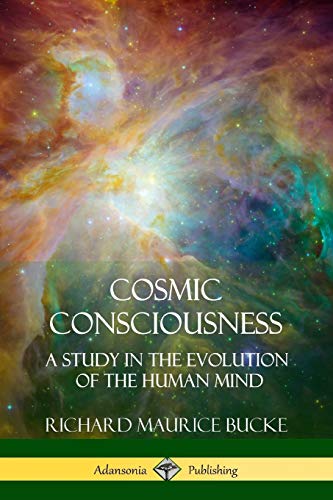
Among early influences on my inward journey were Carl Jung – synchronicities, archetypes and the power of dreams; and Ram Dass (aka, Richard Alpert) – the grace of a guru and life beyond psychedelics; Herman Hesse, (Siddhartha, Journey to the East, Steppenwolf) and the quest for the divine in everyday life; Paramahansa Yogananda – the power of meditation and the living saints who walk among us throughout the ages in all parts of the planet. For the most part these guides of mine embraced Eastern philosopies in one way or another and they opened up a whole new world of exploration. One person stands out in particular as an early and powerful influence, Richard Bucke. His book, published in1901, called Cosmic Consciousness: A Study in the Evolution of the Human Mind was passed on to my friend Herm by his brother Klaus. I then promptly commandeered it. Bucke was a psychiatrist from London, Ontario. His own “mystical” experiences inspired him to seek out others who had similar moments of transcendence, unity and divine grace.
Here is a little of what Bucke wrote of one of his experiences:
“I was in a state of quiet, almost passive enjoyment. All at once, without warning of any kind, I found myself wrapped around as it were by a flame-coloured cloud…. I knew that the light was within me. Directly afterward came upon me a sense of exultation, of immense joyousness accompanied by an intellectual illumination quite impossible to describe. Into my brain streamed one momentary lightning—flash of the Divine Splendor which has ever since lightened my life; upon my heart fell one drop of Divine Bliss, leaving thenceforward for always an aftertaste of heaven. Among other things, I did not come to believe: I saw and knew that the Cosmos is not dead matter but a living Presence, that the soul of man is immortal, that the universe is so built and ordered that without any peradventure all things work together for the good of each and all, that the foundation principle of the world is what we call love, and that the happiness of everyone in the long run is absolutely certain. I learned more within the few seconds that illumination lasted than in all my previous years of study and I learned much that no study could ever have taught.”
He went on to document similar life-transforming experiences by his friend Walt Whitman, as well as historical figures, including Jesus, Saint Paul, Muhammad, Plotinus, Dante, Francis Bacon, William Blake, Buddha, and Ramakrishna. I deeply wanted a taste of that for myself. But how?
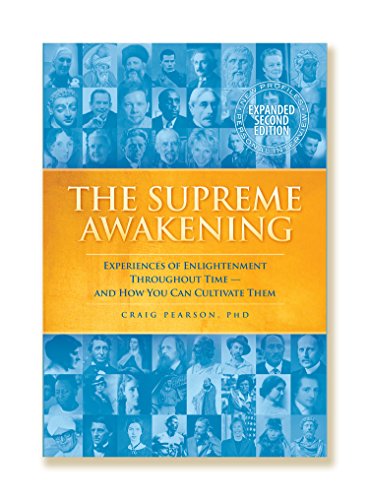
The Supreme Awakening, by Craig Pearson, takes Bucke’s work to a whole new level. How I wish I would have had it when I was growing up and struggling with the meaning of it all. Whereas Bucke marveled at the spontaneous experiences he and others had, he offered no practical techniques for how he or anyone else could experience those timeless realms of the soul other than a glimpse into higher states of consciousness. I deeply felt that these experiences were profoundly real, but unattainable for the ordinary Joe or Jill – like me. Pearson, on the other hand, gives us not only vivid accounts of these states of hightened awareness – experiences of unity, celestial perception, and bliss, but he also shows us how ancient traditions and modern science are joining together to study these states of enlightenment. More than that, he tells how anyone can learn a simple mental technique so that they can effortlessly cultivate these supreme states of consciousness for oneself. No need to retire to a cave in the Himalayas – or even to move to Prince George.
There were certainly moments over the years when I too felt the hint of – something more. Nothing that might qualify as entries into Bucke’s or Pearson’s timeless books, perhaps, but such things like – coincidences that could not be rationally explained away (Jung calls these synchronicities), premonition-type dreams, moments of profound unity with others, bliss. I’ve come to realize that almost everyone I know has had similar experiences. Some friends and others that I know have had deep and lasting experiences of higher states of consciousness. They would most certainly qualify to be in one of these books, and then some.
For my entire life I have been attracted to tales of travels to exotic locales – the Himalayas top the list, the home of blue poppies, yak trains, saints in caves and snow leopards stalking their prey on sheer cliffs. The ancient silk road that linked Cathay and India by camel caravans to the Middle East and Europe; Sinbad’s adventures on the Seven Seas; the hippie Trail across Europe through Persia and Afghanistan to Rishikesh and Kathmandu. Pilgrimages, treks, catching tramp steamers to Australia or the South Seas, train rides across Canada, Siberia, Asia or on the Orient Express. These advenures, alas, have, so far, escaped me this lifetime. Others I have had on the backroads and princely palaces of Rajasthan where I had tea and mango juice with Maharajas; went looking for diamonds in Finland in Feruary; attended a Peace Assembly in Croatia, where artillery firing could be heard during our meditation practice; spent months at a time on TM courses in India, Switzerland, the USA, Spain and Canada; studied aromatherapy in Holland and the USA; lived in Las Vegas; went on cruises through the Mediteranean and to Alaska and visited the temples and beaches and night markets of Cambodia and Thailand; and travelled throughout California and many other states and provinces in North America.
There are still many places my heart aches to see, such as Paris and the lavender fields of Provence, Bali, the Yukon, Tibet, Newfoundland and the Valley of Flowers in India. How many of these places will I get to see in this lifetime? How many other wonderful worlds will I visit whose names, and mysteries and delights are not yet known to me?
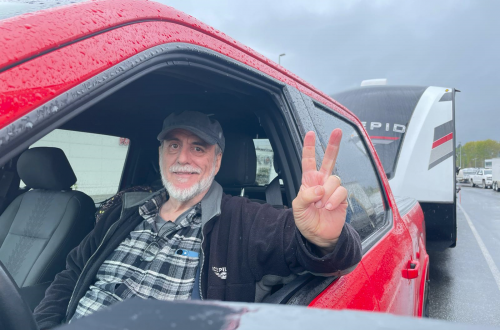
Karin and I are also detemined to explore as many of the backroads of Canada and the USA as we can with our recently acquired truck and trailer. This unit allows us to affordably and comfortably travel to many fascinating places across North America. Our communication set ups allow Karin to continue running her company remotely and for me to work at my writing. This form of travel is a lot more bourgois than my earlier hitchhiking travels across Canada, but it has a romance and challenges all its own. And we certainly get to see and hang out in some of the most beautiful places on earth. In the last two weeks alone we have camped under a rainforest canopy of ancient cedars and Douglas firs on Vancouver Island; sailed on a ferry across the Salish Sea; driven along the spectacular North Shore mountains and the legendary Fraser River; followed the twists and turns and steep climbs and declines of the Hope-Princeton Highway where snow still lies heavy in the high passes and deep forests; watched the terrain turn from the deep green of cedars and moss to the rich textures of pines growing on red rock; then we follow the graceful curves of the Similkameen River Valley with its small picturesque farms, vinyards and apple orchards celebrating the arrival of spring with their delicate white and pink blossoms.
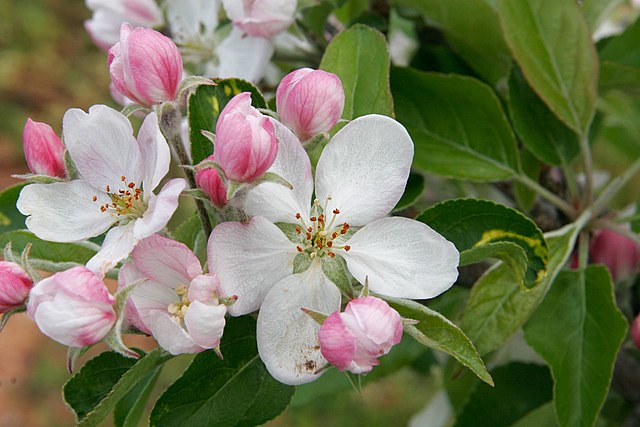
Finally we emerge into the more arid lands of British Columbia’s interior with the scent of sage and antelope brush in the warming sun and a super bloom of bright yellow Okanagan sunflowers decorating the dry slopes and gullies of the surrounding mountains.

See: Image and article: https://www.watermarkbeachresort.com/blog/spring-in-the-land-of-ing/
Nearby, it is commonly said, is Canada’s only true desert, the northern tip of the Sonoran Desert that stretches from Osoyoos though the western USA to Mexico. Except, while, sad to say, its not actually a true desert, because it has a bit too much annual precipitation to qualify. Sorry… (However, it is somehow reassuring to note that a small area around Ashcroft, BC about three hours away, does more closely meet the exacting standards. Somehow, I just want to be able to claim that icy, snowbound Canada has its own desert somewhere, anywhere. [See: https://infotel.ca/newsitem/canadas-only-desert-is-in-bc-but-not-where-you-think-it-is/it75548]
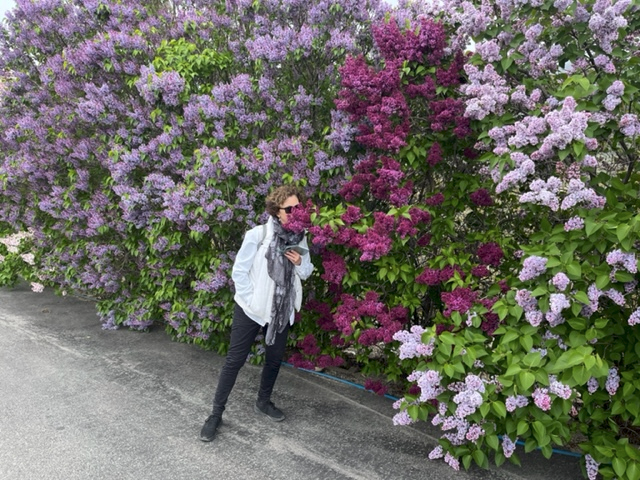
Osoyoos does, however does have many of the characteristics of desert country, high summer temperatures, arid landscape, cacti, rattlesnakes, but just too moist, not that you’d ever notice the cold and damp, especially in the summer months. Along with irrigation, there is enough moisture to support hundreds of vinyards. In early May the vineyards and wineries are just starting to awake from the winter, but orchards are already in their spring glory. Lilacs – dark purple, pale mauve, bright white, even a few pink ones – are seemingly on every farm and in every yard and lining every road. Every stretch of road in the area every brings new wonders and new joys.
My youth was greatly influenced by more earthly travellers like like Jack Kerouac, author of On the Road and Dharma Bums, two of the most widely read books of my generation. Kerouac , of course, was not the first to mythologize life on the road. Jack London chronicled his own incredible travels by rail, ship and dog sled decades earlier. Others writers like John Steinbeck, Tom Wolfe, Robert Service would also feed my wanderlust. As did singers and poets like Leonard Cohen, Bob Dylan and Woody Guthrie. And, naturally for a kid from Alberta, there was Hank Snow, Hank Williams and Montana Slim to sing their tales of box cars, lost loves, broken dreams and the greener pastures just down the road a ways.

All of these writers, thinkers, singers, hobos and spiritual wanderers had an oversize influence on me. Like many others in the 1960s and early 70s I took to the road in search of, well, I’m still not entirely sure what I was looking for in my wanderings. Escape? Adventure? Romance? Enlightenment? All of the above, I suppose. I hitchhiked around Canada, alone and with others, not owning a car until I was 21. I also caught buses and trains when I had a little extra cash, although, I greatly regret, I never hopped a freight. Some of my friends did and I envy them to this day. Had I done so I would have been following a fine tradition as my father rode the rails during the Great Depression travelling from his home in Evansburg, Alberta to various places around Western Canada while looking for work, picking fruit and hops, working in sawmills and aboard a graceful old schooner converted to a humble log barge (*Future story).
“I’ve been everywhere, man
I’ve been everywhere, man
‘Cross the deserts bare, man
I’ve breathed the mountain air, man
Of travel, I’ve had my share, man
I’ve been everywhere.”
– Hank Snow, I’ve Been Everywhere
I would like to think my travels all a great worldly and cosmic adventure filled with the thrill of exploration and discovery, but, in truth, I was in many ways a deeply troubled young man. I love Tolkien’s words, “All who wander are not lost”, but, this was not always the case with me, I definitely should have stopped and asked for directions along the trail, or at least picked up a free Esso road map to the soul. For many years, I was often lost and in need of guidance, direction and purpose. This, I fear, was also the case with many of my friends. When the hippie dream came crashing down it took many of us down with it. Drugs and alcohol certainly took a tragic toll, both at the time and in the years to follow when all the excesses eventually caught up with them. I think sometimes that the colourful trappings of being a hippie overshadowed serious mental and emotional health issues.
For me, I now suspect there was a serious but undiagnosed learning disability that interfered with my schooling and personal life. This problem manifested whenever I had to memorize things like times tables, mathematical or scientific formulas, grammar rules, musical notes etc. I even struggled with subjects and topics that I loved, like remembering song lyrics, dance steps or words to a play I wanted to act in. Faced with these challenges, I would freeze and break into a cold sweat. Drifting off to some la-la-land was often my escape. Countless times, I heard from teachers that I was a daydreamer, I didn’t pay attention, didn’t do my homework, didn’t live up to my potential. Was I a victim or the beneficiary of my wandering mind? Still struggling to tally up the pluses and minuses on either side of that equation.
School was largely a stressful time in my life. I hid my fear, anxiety and shame by being the rebel, the jokester, the philosopher, the hippie wanderer who would disappear from school for weeks at a time while I went to the Easter Be Ins in Vancouver, only to nonchalantly reappear as if I had never been away. My poor teachers. My poor parents. Poor, poor pitiful me.
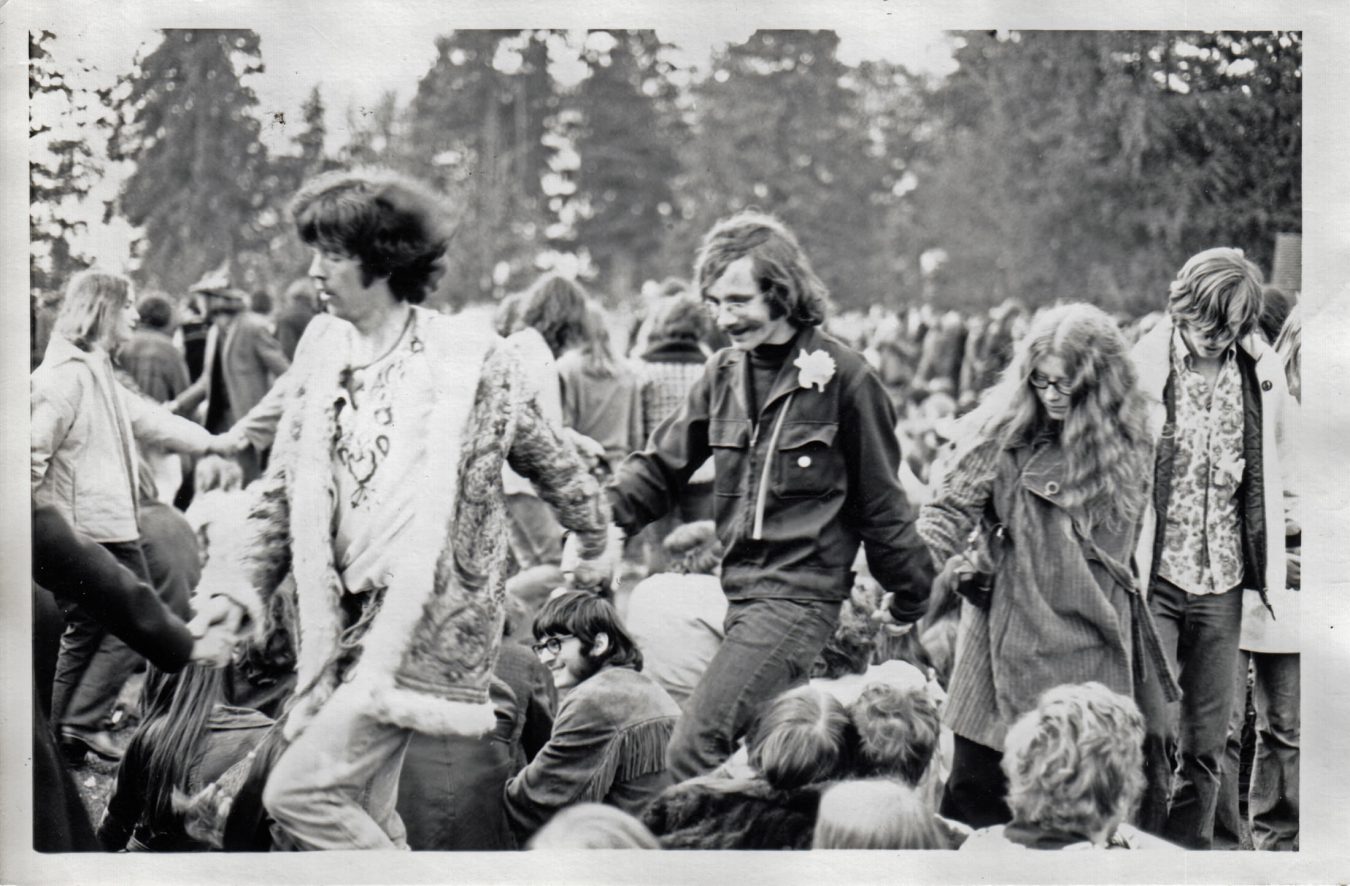
See Montecristo Magazine for article and more groovy photos:
https://montecristomagazine.com/magazine/autumn-2017/the-1972-easter-be-in
This type of learning still does not come easy – where I have to memorize something or a task requires a lot of focus. I wrote these issues off as a teenager by scornfully dismissing the value of formal education over life experience and informal learning. Following in the footsteps of many others in the 60s, I convinced myself that “dropping out” was the answer to many of my personal, social and scholastic woes. I learned to compensate and hide my learning struggles although this required a lot of extra work and stress. For example, although I never finished high school, I went on to earn a Master’s Degree, and even two years of a doctorate program (PhD not completed – long story), but in eight years of university I cleverly avoided exams. I was good in workshops and directed studies and I could consistently produce top quality essays – by working extra hard. So, as much as possible, I took courses that had little or no exam components. Not always easy to find, but I became very resourceful at this manouvering. In fact, sSome of my fellow students even sought my advice on which courses to take – because they preferred exams over dreaded essay writing. Go figure.
I have to now grudgingly admit that many of the fears and concerns of my parents, teachers and others were for good reason. They saw what I could not and knew a day of reckoning would surely come. Not saying that I have a lot of regrets, but I do believe I could have had a full rich and even crazy life without all the struggling, posturing and contorting. A friend who retired from teaching immediately recognized the symptoms I described and assures me that there are now techniques and procedures available to deal with problems such as mine. Oh, boy, I sure hope so.
Some friends of mine escaped the worst of the tumultuous 60s and early 70s through religion or other spiritual practices, the daily grind and well-paid millwork and coal-mining jobs, the complexities of marriage and family life, the pursuit of higher education and careers. Still others carved out a niche for themselves as artists, musicians, farmers and university professors and educators where they could live somewhat responsible and productive lives while still living some semblance of a creative bohemian life.
In thinking about the varieties of wandering that intrigue me and how my inner and outer journeys have shaped me, I often despair for young people today who never had the opportunities for hitting the road. I say this despite the seeming contradictions for my own reasons for “Pulling a Hank Snow”, as my father’s generation used to say. In other words get out of town before the truant officer, lawman, pregnant girlfriend, wife, bill collector, tax man, or the relentless lords of karma catch up to you. (I know, I know, you can run but you can’t hide. Still trying to learn that lesson) But life seems so damned serious today. So much more structured. So much responsibility, studying, planning, saving and investing. Oh, god, I just couldn’t have done it in my teens and early twenties. Its true, I squandered some of my precious time for lack of purpose, focus and direction, but I also cherish the stories and adventures I have gathered along the way. On the other hand, I see some younger people today who have traveled more of the world than I ever have or ever will. And they are also well educated, wise, artistic, enlightened human beings leading extraordinary lives. How the hell do they do it???
I came across an article recently, by Anthony Wexler, an American English professor, who ponders some of these same questions. He teaches a course called “On the Road in America” that explores the travel writing of Jack Kerouac, and others, who have chronicled the romance, myths and realities of hitting the road. For him these works of literature “helped create and sustain that myth, so vital, and so full of joy, sadness and humanity.” He has found, however, that over the years his students “have become less empathetic toward those seekers and free spirits who get on the road and the experiences they have.”

Like me and many of my friends, Wexler read Kerouac’s “On the Road” and it radically changed his life. He dropped out of university and went walk about for a year. As he says in the first person piece, “I realized that I wanted to know firsthand about the fire, the passion and the spiritual longing that propelled Kerouac’s characters to explore the country at such a frenetic pace.” It seems he too, at least for a time, abandoned security and comfort in order to follow the pull of adventure. He apparently has few regrets. As he shares in the article, “The decision to be irresponsible, to make a choice for myself, was a powerfully liberating experience – one that gave me the time and space to wander, to think, to be lost. For me, the road was a site of change and transformation.”
Wexler summarizes so eloquently my own thoughts on the subject of wandering and journeying: “I want to believe that these works and the myth of the road still have value. If not as a blueprint for today’s spiritual seekers then at least as an alternative path, one that remains indifferent to productivity and prestige – values that leave so many young people feeling anxious and stressed out; living for a future that may never arrive.” Well said, I say.
As for me, things have turned out much better than I could ever have imagined, what with all this ceaseless wandering of mind, body and spirit. First of all, I’m still alive which counts for a lot, I’m thinking, especially knowing first hand some of the things I’ve lived through and the number of bullets I’ve dodged (metaphorical only). Today, I have a beautiful home and celestial garden, a wonderful wife who shares my love of travel and discovering new horizons as well as my love of TM. Generally, a healthy, happy life. Pretty sweet! (Too bad Karin gags at the mere mention of history, puns or puddings or the thought of reading my long-winded stories, much favouring a well-crafted paragraph, or, preferably a concise sentence, not like this particular one which was way, way, waaaayyyyyy too long.)
These days I truly believe, naive but eternally optimistic person that I am, that I can wander joyously about this earth – as well as journey through the realms of imagination and the all the other strange and surprising places the soul’s journey takes us, while maintaining my spirit of adventure and wonder and still be a responsible, industrious and conscientious citizen of the world.
My wanderings, for the sake of this Blog, will fall roughly into several categories, for example Boystown, inspired by my childhood in the foothills of the Eastern slopes of the Canadian Rockies. Hippie Trails will recount my tales & travels in the 60s and 70s, as well as some other wonky stuff thrown in, just because I can. Cowpunk for example, where I take the expression “All Hat – No Horse”, to a whole new range. The Travels section will follow my comings and goings and musings during more recent journeys. I also want to populate a section, what I will call something like WonderBeauty, stories of inspiration, synchronicities, beauty, and such. I’m hoping to create a space for other contributors, like my mother, who wrote many delightful stories I would like share. If all goes according to plan, there should even be room for you – although your good reputation might suffer grievously from being posted here.
Hopefully after reading this you will get some idea of the trips we will be taking together. Welcome fellow wanderer to my world and my storied wanderings through it.
Love and Peace, Wayne
Wayne


One Comment
Bob Howe
I am engaged, marveled and reminded of similar wanderings of my own.
You have my interest and encouragement to continue creating and posting.
Bob