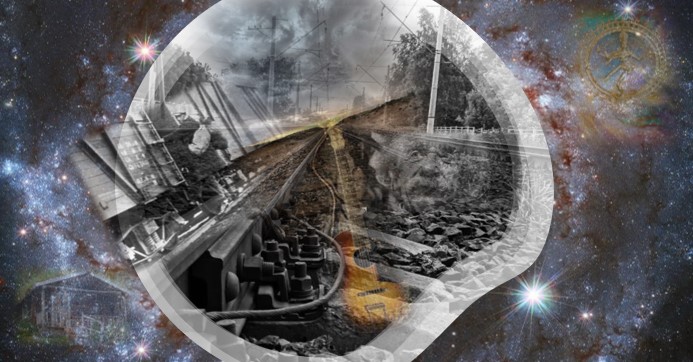
Night Train: From the “Tales of the Imaginary Traveller”
Night Train
From the “Chronicles of the Imaginary Traveller”
by
Wayne A. MelvinAt that distant point on the far horizon….
Where the train tracks converge
At the far edge of this vast universe
What becomes of the Night Train then?
And what becomes of the physicist-poet
Who rides that Kerouac freight,
The Quiet Man in the mackinaw coat and slouch hat
Who strums his guitar through the cold night
As worlds and visions and lifetimes
Rush by the open boxcar door?
Under the light of the known moon pass dark forests,
There are deserts and oceans and snow-clad mountains
There are palaces and forts and thatched huts of wattle and daub
And there are celestial cities and temples in the mist
Worlds spin by, then the outer moons, then glistening stars and flaming galaxies
And the Night Train gathers speed in its rush to that far horizon
The Quiet Man whistles gently through the dark night
Knowing that by dawn
The Night Train will have passed the border lands
Stripping him clean of memories and dreams and time and songs
At the shimmering gates of the horizon — other mysteries await….
As the Night Train rattles down those ever-converging lines of track
And the boxcar shudders and shakes and steel sparks upon steel
The vaporous constellations wheel overhead
Spilling starfields across the dark expanse of the heavens
And the Quiet Man rides through that quickening night
Knowing that somewhere down the line the tracks converge
And not knowing –
How many more train songs he has left to sing.
For Michael Piper, a fellow traveler, who dreams of riding the rails (June 2005),
and for Rusty Melvin & Tets Kitaguchi who did (1930s).
And also for Rhonda Roy, Poet & Micheal Weiss, Physicist, who helped me with my science homework.
**********************************************************
“Although many of the theorems of hyperbolic geometry are identical to those of Euclidean, others differ. In Euclidean geometry, for example, two parallel lines are taken to be everywhere equidistant. In hyperbolic geometry, two parallel lines are taken to converge in one direction and diverge in the other.” –
“The first published works expounding the existence of hyperbolic and other non-Euclidean geometries are those of a Russian mathematician, Nikolay Ivanovich Lobachevsky, who wrote on the subject in 1829, and, independently, the Hungarian mathematicians Farkas and János Bolyai, father and son, in 1831.”




4 Comments
Karan Croy
Love the poem.
Sandie Melvin
Beautiful, Wayne. ❤️
Steven Cox
Good poem. Very nice.
Sharon
Wonderful poem, Wayne. I had no idea you were a poet.