Workcation: 5 Things You Need to Know When Living and Working on the Road – Parts 1 & 2
This posting comes in two parts. Part 1 is written by me and is a somewhat light-hearted look at the nomadic life that my wife Karin and me have been living of late. It is primarily an introduction to Part 2, written by Karin, from her professional perspective as a financial planner. It offers some very valuable practical information for others wanting to spend more time working & travelling in an RV, such as we are. It is also intended as a guide for others who are or living/working away from home base for long periods of time, perhaps from their lakeside cottage or vacation property. We hope you find the very different sections both useful and entertaining.
Part 1
By Wayne A. Melvin
Hello Friends,
As most of you know by now, Karin and I have been spending much of our life on the road these days. We live and work out of our Intrepid travel trailer, pulled by Big Red, our faithful Ford150. We have had some wonderful adventures and hope to keep on living this mobile lifestyle for the foreseeable future.
I would be kidding you though if I said it was all romantic and fun. Sometimes we think we are in way over our head – like when we find ourselves trapped in a dead end cul-de-sac or travelling on some death-defying mountain road, or navigating a multi-lane California cloverleaf, or simply backing into a tight parking spot at the end of a long day of driving. Oh, yeah, point to self, don’t drive under low-hanging oak trees in busy shopping-centre parking lots. (We called in a lot of road angels to get ourselves out of that debacle, including the staff of a nearby restaurant and an off-duty emergency response team. We’re still finding oak leaves and acorns in weird and unexpected places).
The challenges that come with adventures are seldom comfortable and are often better in the telling than in the living. What is seldom seen or heard about when living and working on the road is all the organizing and planning that goes on behind the scenes. That’s Karin’s forte. She is an organizer by nature, a psychologist and MBA by training, a financial planner and entrepreneur by profession, an educator by choice, a cartographer by vocation and a navigator by necessity. She’s also the one who prepares – and enforces – the budgets for our travels. Fortunately, for both of us, we both love to travel and explore new places, so we overlook or overcome the difficulties we face and head out on the road again. Lessons learned (I hope).
Karin is all about creating systems. To solve problems. To prevent problems. To make things hum along smoothly even when there are unexpected bumps along the road, both metaphorical and very real ones. She is Co-Founder and CEO of Money Coaches Canada, an advice-only financial planning and money coaching company that caters primarily to professionals and similar middle-income earners. (They offer independent advice and don’t sell investments, insurance or other such products.) The goal is to help individuals and families better manage their finances and reduce their financial stress so they can “live the life they want to live”. Karin creates systems for her company, but she also does this for us to keep us safe and sane, especially when it is time to move locations or set up operations at a new site.
She developed a detailed check off list for hooking up the trailer and another for breaking camp. We check and double check everything like a pilot and co-pilot would do before taking flight – and we nearly always find some thing that needs attention. She also has a large collection of physical and online maps and a special app for trip planning especially designed for RV owners. Still another list on my phone keeps track when I am shopping for groceries and various truck, trailer and travel necessities. To-do lists haunt me at every turn. Sigh!
Part of our aim every day on every trip is to leave Karin free to do her work. Unlike me – a retired History professor, Blog-post writer and itinerant aromatherapist – she has a real job, and a very demanding one at that.
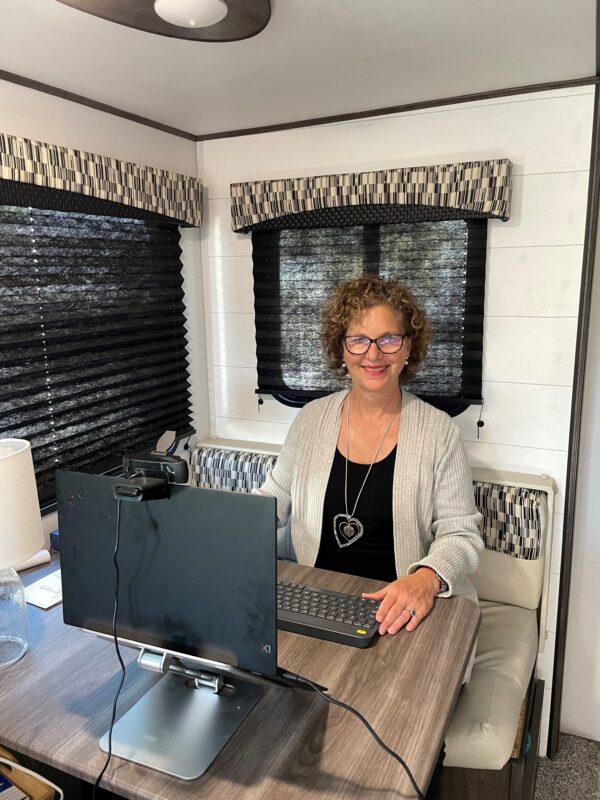
In addition to Karin and her business partner Sheila Walkington, the firm has more than 20 associates and employees operating out of several different time zones across the country. Needless to say, things get hectic and organization is key to running the firm successfully. Karin has a high-tech workstation in the RV with all the essential gadgets and gizmos she needs. She also ensures that she always has dedicated, high security internet links for her phone and Zoom calls and other online work. All the things required of a home business, but also with the unique demands of a changing physical and communications landscape, different WiFi systems, as just one major example. Tight working space is another.
There is a door that separates her office from my decidedly more modest “studio” – a tiny closet in the bedroom – where I work on my various research, writing and art projects. Shelves overhead contain dozens of essential oils and other materials for my Maharishi Aromatherapy consultation practice. Very fragrant working quarters, albeit a wee bit cramped, especially for board meetings, large marketing presentations, and meetings with ever boisterous New York publishers and out of control Hollywood moguls. There is yet another door in the bedroom, one that leads to the outside. This allows me to spirit in and out of the trailer so I can do my chores or other solo activities (like hiding from my job jars) without disturbing Karin at her desk. A closing door to the bedroom and a second exit/entrance to the outside were essential factors when choosing our RV, a 25-foot Intrepid, by Riverside RV. https://goriversiderv.com/intrepid-rv/
We’ve learned a lot on how to make this all this craziness work. Now Karin is pleased to share some of her hard-won knowledge and experience with others who live and work on the road. Her ever-practical advice also readily applies to those who work remotely or on location at their cabin or vacation property. Recently she wrote an article on “workcations” for her company’s Blog site, about how to make such unconventional lifestyles less stressful, more efficient and sustainable – and more fun. I thought you would enjoy reading the full article and hopefully some of you, or someone you know, will find it useful for your own travels.
You can find the article on my Blog Site: Wayne’s Wanderings, Stories for Wanderers, found at: https://wayneswanderings.ca. The article is called, “Workcation: 5 Things you need to Know when Living and Working on the Road”, located under the Contributing Authors section. You can go directly to it here [Feel free to share the link]:
https://wayneswanderings.ca/workcation-5-things-you-need-to-know-when-living-and-working-on-the-road
If you are curious or want more information about Karin’s company and the good work they do, I suggest you check out the website for Money Coaches Canada. I especially recommend their free newsletter and the large selection of articles written about the company in the Globe & Mail, Financial Post and many other publications. Here is the link: https://moneycoachescanada.ca
Happy Trails and Happy Workations,
Wayne
*****************************************************************************************************
Workcation: 5 Things you need to Know when Living and Working on the Road – Part 2
By Karin Mizgala, CFP®
Co-founder and CEO Money Coaches Canada
To say that my husband Wayne and I are quite different is an understatement. He’s an artist and I’m a financial planner. Say no more! However, the one thing we are in perfect agreement on is that we love road trips. Any chance we get, we hit the road and often use this opportunity to dream and set goals and intentions for our life together.
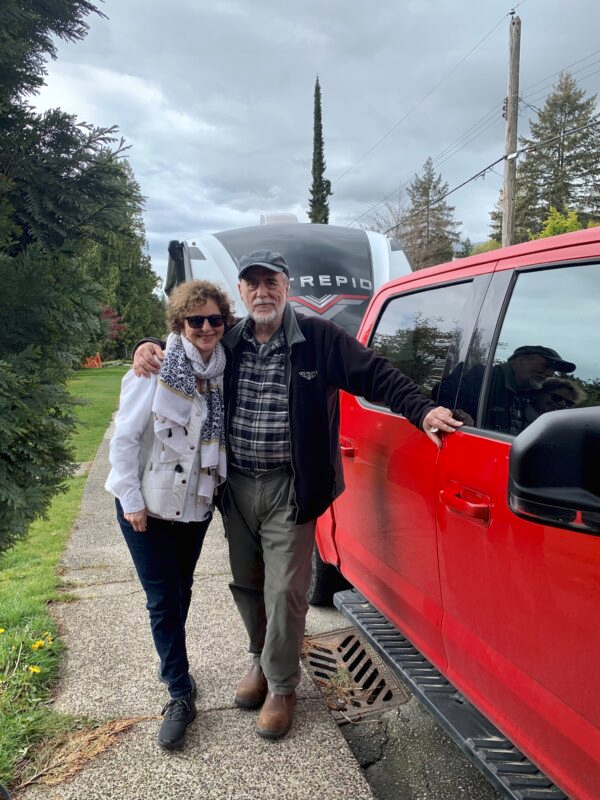
Over the years one of our big dreams was to buy an RV and bring our home with us on our adventures.
We hit a few roadblocks when the time came to make this a reality. I had envisioned a little cozy 20-foot van and he had his sights on a Willy Nelson celebrity bus to the tune of $300K+. With my financial planner hat on, I quickly kiboshed that idea.
We (ok I) set a budget and started shopping. Wayne had always wanted a big red truck, so we settled on a modest truck and travel trailer to see if this life was for us.
While Wayne is a retired history prof, I’m still several years away from retirement so a big consideration was whether it was possible (or even desirable) to work on the road. I knew that, at least in theory, I could work from anywhere but was it doable in practice?
If you’re considering working on the road, here are a few of the lessons that we learned so far with some input from my intrepid traveler colleague Steve Bridge:

1.) You need to be very, very organized
Whether you’re renting a condo or travelling in an RV, it’s a lot harder to be spontaneous especially if you’re trying to work along the way. Planning and researching routes, flights, and accommodations is hugely time consuming and can be especially complicated when fitting travel into your work schedule.
I started by creating a spreadsheet with destinations, mileage, accommodations, and costs. It took hours and hours of research to plot the routes and to read countless google reviews before booking campgrounds. I’ve recently started using an online service called RV LIFE Trip Wizard which makes planning a bit easier.
My colleague Steve Bridge, who has worked remotely for a few months at a time in Mexico recommends that you connect with someone who has ‘boots on the ground’ for local knowledge and who can answer questions honestly about your desired destination.
Do your best to have a contract for your rental accommodation. Send the minimum deposit acceptable (which isn’t necessarily the amount asked for). Steve also recommends confirming and reconfirming accommodation arrangements. You want to avoid any unnecessary inconveniences especially if you have deadlines and work commitments.
2.) Be prepared financially for the unexpected
On my very first camping trip, I blurted out as if I were a veteran RVer: “There’s always something that happens when you’re camping!”. I am still being teased about my “expertise”, but turns out, I was oh so right.
Despite all the advanced planning and budgeting that we did upfront, unexpected repairs and costs cropped up. Currency fluctuations, inflation and lack of firsthand knowledge of a location can also add to the overall expense of your adventure.
Make sure you have a detailed list of all the anticipated expenses and add a minimum of 20% to whatever you’ve budgeted for your travels as a contingency fund.
You’ll also need to decide what to do about your home while you’re away. Given the extended travel we wanted to do, we decided to rent the suite in our home. This gave us peace of mind that someone was looking after the house while we were away, and also added a few dollars to our travel fund.
If you’re renting your home for an extended period of time, be sure to update your home insurance and talk to an accountant or financial planner about the tax implications for claiming expenses and the principal residence capital gains exemption.
3.) Technology isn’t always your friend
One of the biggest considerations for working away from your usual home or office is the reliability and security of internet access and cell service. There is a dizzying array of gizmos and emerging technologies to address this issue but many of these options are not available or reliable everywhere.
When researching the locations for the working portion of our travels, strong secure Wi-Fi and cell service were non-negotiable. Most campgrounds or hotels have Wi-Fi, but most often are not secure. We avoided accommodations that didn’t have secure Wi-Fi unless we were vacationing and didn’t need to access my work computer. We opted for a cell booster so I could hotspot if secure Wi-Fi wasn’t available.
Steve recommends doing as much research as possible before you book your accommodations and ideally have someone at your planned destination run a Wi-Fi speed test to save headaches when you arrive, especially if you’re planning to use video conferencing.
We’re watching satellite Wi-Fi options like Starlink for our next big trip.
4.) Get creative about staying healthy
One of the things I love most about being on the road is that everything seems new and fresh. The downside is that the routines of your regular home life may be left behind, especially ones related to health and wellness.
Because of COVID-19, there are now a lot more online options for staying fit. I regularly attend 2 live online dance and fitness classes a week, have access to “on demand” work-out videos and have a set of weights with me. Admittedly it’s a bit of a challenge in a tight space, but it’s also been fun figuring out how to make it work.
A lot of the RV campgrounds also have fantastic options for activities on site, so I’ve been able to fit in dance classes or a swim between meetings. And if you’re working in a warmer weather climate during the winter, there aren’t many excuses not to enjoy the great outdoors. Hiking and biking are great ways to explore new surroundings.
Travel insurance can be a big-ticket item if you’re working outside Canada for any length of time. After age 60, it can be more difficult to qualify for coverage. You may need to consider travel insurance even if you’re travelling outside your province within Canada. While most provinces health programs cover out-of-province medical care, there are some exceptions and administrative issues, so do your research beforehand.
You also need to make sure that you don’t lose your Canadian health coverage by being out of your province or country for too long. Most provinces require minimum residency of between 4 and 6 months to continue with health insurance coverage.
5.) Be open to new ways of working and living
While life on the road can be exhilarating and enriching, it’s not the same as a relaxing beach vacation. It brings new responsibilities and activities that may be unfamiliar and sometimes very stressful. It took Wayne and I several months to settle into new rhythms and patterns and to feel more comfortable with propane heaters, emptying holding tanks (his job, not mine!), backing up the trailer – hmm, still not comfortable with that one!
It was a great relief for us to find so many mentors and “angels” who helped us out or came to our rescue along the way. Thanks to all of them we’re still happy campers… mostly!
One of my big lessons learned was that it’s too stressful to work when we’re on the move. We now book chunks of time in one location where we can settle in and “live” in that location for at least a month at a time. Weekdays are workdays but on the weekends we get to enjoy what our new surroundings have to offer.
If you’re working and travelling as a couple or a family, it may be difficult to synch schedules and to share a smaller space. Depending on the size of the accommodations and what your co-travellers are doing, Steve recommends finding a workspace to separate vacation from work and to ensure privacy and confidentiality. One of the reasons we opted for a truck & trailer RV option was to give us more flexibility so that Wayne could use the truck when I was working.
We also chose an RV model with a door that closed off a separate space with a very tiny workspace (ok, a closet) for Wayne. Without his usual home and garden activities and responsibilities, Wayne is using our “live away” time as an opportunity to rekindle some of the writing projects that he’s hoped to energize for years.
Life on the road has introduced us to many new places, but more importantly it’s opened us up to new visions and options for fulfilling our dreams and desires.
Surprisingly, living in a small space has been a lot easier than we imagined. We’ve had to be more patient with each other and invented a few new do-si-do dance moves, but overall, it confirmed my suspicion that we need a lot less than we have. Wayne still sometimes covets the bigger rigs, but for now, we’re happy with what we have and the adventures ahead. Stay tuned!
If you need help re-imagining your money and your life, book a complimentary session with a money coach.






3 Comments
Joan Melvin
I marvel at the lifestyle you two have carved out for yourselves. The phrase, “living the dream” is a peffect descriptor for you.
Bob Howe
Great description of the opportunities and challenges in order to realize your dreams.
“Happy are those who dream dreams and are ready to pay the price to make them come true” – Leon Joseph Suenens
Ruth Anne
Awesome description of all the planning you have done to make this work, Karin! Congratulations to you both on living the dream. 👍💖